
Thời gian làm việc: 8h00 - 17h từ Thứ 2 đến Chủ nhật
Hotline : 0866484586
Email: ledinhhai789it@gmail.com
Cryptocurrency networks crucially rely on digital signature schemes, which are used as an authentication mechanism for transactions. Unfortunately, most major cryptocurrencies today, including Bitcoin and Ethereum, employ signature schemes that are susceptible to quantum adversaries, i.e., an adversary with access to a quantum computer can forge signatures and thereby spend coins of honest users. In cryptocurrency networks, signature schemes are typically not executed in isolation, but within a so-called cryptographic wallet. In order to achieve security against quantum adversaries, the signature scheme and the cryptographic wallet must withstand quantum attacks. In this work, we advance the study on post-quantum secure signature and wallet schemes. That is, we provide the first formal model for deterministic threshold wallets and we show a generic post-quantum secure construction from any post-quantum secure threshold signature scheme with rerandomizable keys. We then instantiate our construction from the isogeny-based signature scheme CSI-FiSh and we show that our instantiation significantly improves over prior work.
Link: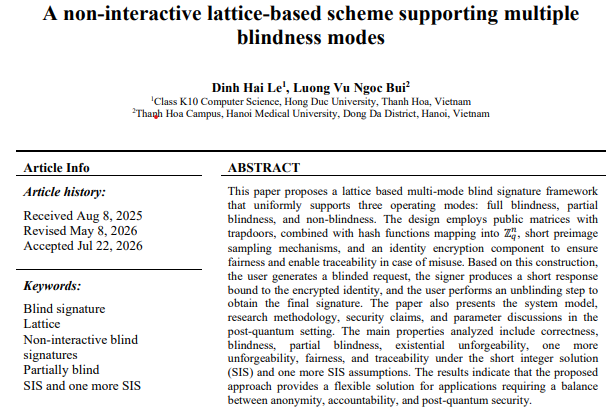
This paper proposes a lattice based multi-mode blind signature framework that uniformly supports three operating modes: full blindness, partial blindness, and non-blindness. The design employs public matrices with trapdoors, combined with hash functions mapping into ℤ𝑞 𝑛 , short preimage sampling mechanisms, and an identity encryption component to ensure fairness and enable traceability in case of misuse. Based on this construction, the user generates a blinded request, the signer produces a short response bound to the encrypted identity, and the user performs an unblinding step to obtain the final signature. The paper also presents the system model, research methodology, security claims, and parameter discussions in the post-quantum setting. The main properties analyzed include correctness, blindness, partial blindness, existential unforgeability, one more unforgeability, fairness, and traceability under the short integer solution (SIS) and one more SIS assumptions. The results indicate that the proposed approach provides a flexible solution for applications requiring a balance between anonymity, accountability, and post-quantum security.
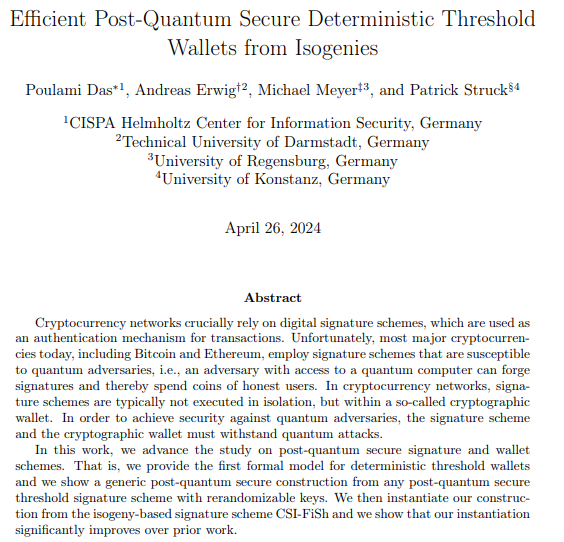
Cryptocurrency networks crucially rely on digital signature schemes, which are used as an authentication mechanism for transactions. Unfortunately, most major cryptocurrencies today, including Bitcoin and Ethereum, employ signature schemes that are susceptible to quantum adversaries, i.e., an adversary with access to a quantum computer can forge signatures and thereby spend coins of honest users. In cryptocurrency networks, signature schemes are typically not executed in isolation, but within a so-called cryptographic wallet. In order to achieve security against quantum adversaries, the signature scheme and the cryptographic wallet must withstand quantum attacks. In this work, we advance the study on post-quantum secure signature and wallet schemes. That is, we provide the first formal model for deterministic threshold wallets and we show a generic post-quantum secure construction from any post-quantum secure threshold signature scheme with rerandomizable keys. We then instantiate our construction from the isogeny-based signature scheme CSI-FiSh and we show that our instantiation significantly improves over prior work.
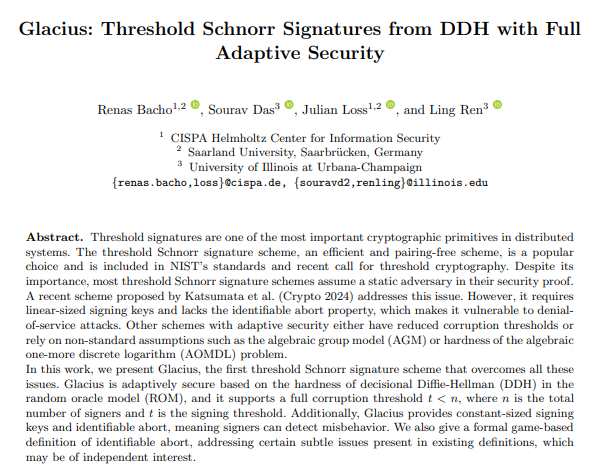
Threshold signatures are one of the most important cryptographic primitives in distributed systems. The threshold Schnorr signature scheme, an efficient and pairing-free scheme, is a popular choice and is included in NIST’s standards and recent call for threshold cryptography. Despite its importance, most threshold Schnorr signature schemes assume a static adversary in their security proof. A recent scheme proposed by Katsumata et al. (Crypto 2024) addresses this issue. However, it requires linear-sized signing keys and lacks the identifiable abort property, which makes it vulnerable to denialof-service attacks. Other schemes with adaptive security either have reduced corruption thresholds or rely on non-standard assumptions such as the algebraic group model (AGM) or hardness of the algebraic one-more discrete logarithm (AOMDL) problem. In this work, we present Glacius, the first threshold Schnorr signature scheme that overcomes all these issues. Glacius is adaptively secure based on the hardness of decisional Diffie-Hellman (DDH) in the random oracle model (ROM), and it supports a full corruption threshold t < n, where n is the total number of signers and t is the signing threshold. Additionally, Glacius provides constant-sized signing keys and identifiable abort, meaning signers can detect misbehavior. We also give a formal game-based definition of identifiable abort, addressing certain subtle issues present in existing definitions, which may be of independent interest.

Abstract. We present an RSA threshold signature scheme. The scheme enjoys the following properties: 1. it is unforgeable and robust in the random oracle model, assuming the RSA problem is hard; 2. signature share generation and verification is completely non-interactive; 3. the size of an individual signature share is bounded by a constant times the size of the RSA modulus.

Abstract. Existing threshold signature schemes come in two flavors: (i) fully private, where the signature reveals nothing about the set of signers that generated the signature, and (ii) accountable, where the signature completely identifies the set of signers. In this paper we propose a new type of threshold signature, called TAPS, that is a hybrid of privacy and accountability. A TAPS signature is fully private from the public’s point of view. However, an entity that has a secret tracing key can trace a signature to the threshold of signers that generated it. A TAPS makes it possible for an organization to keep its inner workings private, while ensuring that signers are accountable for their actions. We construct a number of TAPS schemes. First, we present a generic construction that builds a TAPS from any accountable threshold signature. This generic construction is not efficient, and we next focus on efficient schemes based on standard assumptions. We build two efficient TAPS schemes (in the random oracle model) based on the Schnorr signature scheme. We conclude with a number of open problems relating to efficient TAPS.

Consider a scenario where Alice stores some secret data s on n servers using a t-out-of-n secret sharing scheme. Trudy (the collector) is interested in the secret data of Alice and is willing to pay for it. Trudy publishes an advertisement on the internet which describes an elaborate cryptographic scheme to collect the shares from the n servers. Each server who decides to submit its share is paid a hefty monetary reward and is guaranteed “immunity” from being caught or prosecuted in a court for violating its service agreement with Alice. Bob is one of the servers and sees this advertisement. On examining the collection scheme closely, Bob concludes that there is no way for Alice to prove anything in a court that he submitted his share. Indeed, if Bob is rational, he might use the cryptographic scheme in the advertisement and submit his share since there are no penalties and no fear of being caught and prosecuted. Can we design a secret sharing scheme which Alice can use to avoid such a scenario? We introduce a new primitive called as Traceable Secret Sharing to tackle this problem. In particular, a traceable secret sharing scheme guarantees that a cheating server always runs the risk of getting traced and prosecuted by providing a valid evidence (which can be examined in a court of law) implicating its dishonest behavior. We explore various definitional aspects and show how they are highly non-trivial to construct (even ignoring efficiency aspects). We then give an efficient construction of traceable secret sharing assuming the existence of a secure two-party computation protocol. We also show an application of this primitive in constructing traceable protocols for multi-server delegation of computation.

Since their introduction by Itakura and Nakamura in [IN83], multisignatures have been extensively studied, and yet no formal definition of this notion has been provided to date. This lack of formalism has led to some confusion as to the precise meaning of multisignature, as well as to some proposals that have been subsequently broken. We thus wish to address both problems.

We revisit the definition of unforgeability of blind signatures as proposed by Pointcheval and Stern (Journal of Cryptology 2000). Surprisingly, we show that this established definition falls short in two ways of what one would intuitively expect from a secure blind signature scheme: It is not excluded that an adversary submits the same message m twice for signing, and then produces a signature for m0 6= m. The reason is that the forger only succeeds if all messages are distinct. Moreover, it is not excluded that an adversary performs k signing queries and produces signatures on k + 1 messages as long as each of these signatures does not pass verification with probability 1. Finally, we proposed a new definition,

This document specifies an RSA-based blind signature protocol. RSA blind signatures were first introduced by Chaum for untraceable payments. A signature that is output from this protocol can be verified as an RSA-PSS signature. This document is a product of the Crypto Forum Research Group (CFRG) in the IRTF

Blind digital signatures were introduced by Chaum. In this paper, we show how security and blindness properties for blind digital signatures, can be simultaneously defined and satisfied in the common reference string model, assuming an arbitrary one-way trapdoor permutation family. Thus, this paper presents the first complexity-based proof of security for blind signatures.

NGHIÊN CỨU PHÁT TRIỂN MỘT SỐ LƯỢC ĐỒ CHỮ KÝ SỐ MÙ, CHỮ KÝ SỐ TẬP THỂ MÙ DỰA TRÊN CÁC CHUẨN CHỮ KÝ SỐ

Đề thi thử Vstep số đại học hà nội

Bảng tóm tắt lý thuyết, công thức Hóa 12 cả năm ngắn gọn được soạn dưới dạng file word và PDF gồm 20 trang
![[Cô Vũ Mai Phương] Kiến thức trọng tâm về Mệnh đề quan hệ](/uploaded/TaiLieu/20201219/485d0129-b6ac-4829-87f8-4dc6f13ef12aMỆNH-ĐỀ-QUAN-HỆ.png)
Kiến thức trọng tâm về Mệnh đề quan hệ
![[Cô Vũ Mai Phương ] 20 chuyên đề ngữ pháp Tiếng Anh ôn thi THPT Quốc gia](/uploaded/TaiLieu/20201219/bf97de01-d0d7-4a3b-b560-086566014e20download.png)
20 chuyên đề ngữ pháp Tiếng Anh ôn thi THPT Quốc gia

Điểm chung ở những doanh nhân làm giàu chân chính là họ rất trân trọng đồng tiền do mình làm ra và rất có ý thức trong chi tiêu, không bao giờ tiêu xài hoang phí.